BlogLovin' Teachers Pay Teachers Email Pinterest Facebook Image Map

Sunday, September 7, 2014

Creating Our Class Promise

The first week of school is critical for setting the tone for the rest of the year. It can be hard to create a classroom community in the midst of setting expectations, reviewing school rules, and establishing procedures, but it's the most important thing you can do. With a well established classroom community, everyone becomes invested in the success of everyone else.  Thankfully, there is a way to combine many of your first week priorities into one meaningful activity - creating a class promise. 


Disclaimer- this post contains affiliate links which means that I earn a small amount when you make purchases (at no extra cost to you). However, my promise to you is that I am only sharing my honest opinions and I will never promote something I do not believe in.

I first found out about class promises when I read Debbie Miller's Reading With Meaning. I had been creating rules with my class for a few years, but I loved the idea of making a promise to each other instead. I've been creating class promises during the first week of school ever since. They are posted in the classroom and referred to frequently throughout the school year. Students aren't just accountable to me for following school rules, they are accountable to each other as well. 

It's an easy and fun process to create the promise. Students are very engaged as they get to decide what will be included.


I start by reading my poem, A Kind and Caring Classroom We talk about what a kind and caring classroom would look like. We discuss the meaning of the poem and why showing kindness and caring for one another would help our class to have a good year. We share examples of kindness and talk about how we feel when others treat us with kindness. We also talk about how we feel when others are unkind. 

If you don't have the poem (available in my Teachers Pay Teachers store), you can simply start a discussion about what kind of classroom students want to be in this year. 


We make anchor charts to show what we would do or say if we were showing kindness and caring. I use a template from my school's positive discipline training to organize the student responses. We make a chart for showing kindness, another one for showing respect, and a third for helping each other learn.
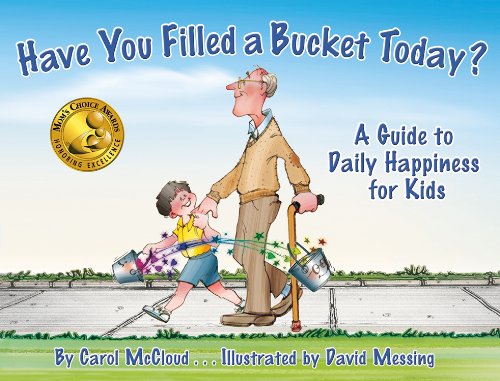


During that first week, I also read Have You Filled a Bucket Today? by Carol McCloud.  We make another anchor chart to compare bucket filling and bucket dipping. I'm always amazed by how insightful the students are in these discussions.  They show remarkable empathy and understanding.  


Finally, we are ready to write.  I use a shared writing model for composing the promise. We start out by thinking about what kind of classroom we want to be in. That first sentence is very important, as it informs the rest of the promise. In other words: If this is what we want, how are we going to make it happen? With my guidance, the students decide what we need to include and help me to compose the sentences. It takes us a couple of days to finish, but finally, we have a finished promise.

There is one more step to make it official.  Everyone in the class, including me, needs to sign the promise. To make it even more personal and meaningful, I have the students create a representation of themselves to post beside the promise. You can see one of mine on the right. After all of the students finish their people and sign the promise, we are finished.

Here's our Class Promise for the 2014-2015 school year.

This is our class promise from the 2016-2017 school year.


Sometimes the kids will surprise you with their creativity! I love the cowboy version of himself that one of my kids created.

What do you do during the first week of school to establish a positive classroom climate?  Please share your ideas and strategies in the comments below.

Until next time,

Sunday, July 6, 2014

No Worksheets Required!

Would you like to implement an easy to prepare, no-fuss, but lots of fun weekly activity in your K-3 classroom? Try starting a Poem of the Week.  You can address an amazing variety of objectives with a minimum of copies or teacher preparation. No worksheets are required!


Disclaimer- this post contains affiliate links which means that I earn a small amount when you make purchases (at no extra cost to you). However, my promise to you is that I am only sharing my honest opinions and I will never promote something I do not believe in.


Implementing a Poem of the Week in Your Classroom

Where to find poems:
When I first started with Poem of the Week, I used this resource:
This book includes great poems for use in the primary classroom.
They are great for tying in with word study.

A Poem a Day
As I became more comfortable with using poetry in my classroom, I began adding poems from other resources.            

I also find poems through online searches and, of course, on Teachers Pay Teachers.  When I can't find what I need, I write my own.

If you need a poem to get you started, you can download a sample from my Kind and Caring Classroom set here. To find this and more poem of the week resources, you can visit my TPT store, Theresa's Teaching Tidbits.


Once you start collecting poems, organize them in a binder. You'll be able to reuse poems from year to year, making for even less preparation time!

How to choose a poem:  
Think about your curriculum and your classroom needs. I try to make sure my poem of the week will help me to address more than one goal.  I use poems to address social issues in the classroom as well as to teach concepts and skills. I've found poems that connect to math, science, social studies, and of course, phonics and other reading skills.

Scheduling your Poem of the Week time:
Schedule a Poem of the Week time at a consistent time each day. I usually like to schedule the activities at the beginning of our literacy time.  You'll need to plan on about 15 - 20 minutes for the day you introduce the poem and read it for the first time. For the rest of the week, plan on about 5 - 10 minutes per day, depending on the activity.

Organizing the Student Poems:
Students will store poems in a 3-pronged folder or a 1 inch binder.  I prefer the binder as students seem to find this easier to manage.  I have used the folders however, and they work well, too. Have your students personalize the binder or folder by making a cover entitled: My Poetry Folder (or another title of your choosing).


Each student will need his/her own copy of each week's poem.  Use a 3-hole punch immediately after copying the poems to make it easy for students to add to their notebooks. 

Optional: You can add a Table of Contents page at the beginning of the notebook to help students organize and find the poems.

How to use the poem throughout the week:

Day 1:  Introduce the poem and discuss its meaning.

  • Project the poem on an interactive whiteboard, make a transparency and use the overhead projector, or make sure students have their own copy of the poem.
  • Read the poem to your students as they follow along.
  • Ask students to talk about what the poem means to them. This can be done whole group or as a “Turn and Talk” with a partner. Briefly discuss any unfamiliar vocabulary. Encourage students to make connections with their own lives or books they have read. 
  • Ask students to join you as you read the poem a second and, if desired, a third time. Have students add the poem to their poetry binder.
Day 2 – 5: Choose one area of focus for rereading each day.
Focus on Comprehension:
Choose a comprehension strategy to reinforce such as visualizing, retelling, or making connections.  Hold a guided discussion after rereading the poem. You may choose to have a follow-up activity involving a written response (text-to-self connection) or illustration (visualization).
Focus on Vocabulary:
Introduce or discuss unfamiliar vocabulary. Model using context clues to figure out definitions.  Have students write or illustrate definitions in their reading response notebooks.
Focus on Phonemic Awareness/Phonics:
Look for rhyming words or alliteration.  Have students highlight words on their copy of the poem using highlighters or highlighter tape.  Generate additional words that fit the rule and write them on the board or an anchor chart. 
Focus on Fluency:
Emphasize reading with rhythm, expression, or feeling. Experiment with different rhythms or emotions.  Be silly and read the poem in a whisper voice, squeaky voice, monster voice, robot voice, etc.  After doing so, reread the poem with appropriate fluency.
Choral read: Everyone reads the poem together after teacher gives a signal such as, “Ready, set, read.”

Echo read: Teacher models reading each line or stanza. Students echo the teacher’s phrasing and rhythm as they read their own copies of the poem.

Continue the learning
After students have worked with the poem all week, they are very familiar with it. This makes it a great resource for a poetry center activity or for fluency practice.  My students even enjoy rereading the poems during their Reader's Workshop time.  

School-Home Connection
Once a month, have students bring home the poetry notebook to share with their families.  I place a parent letter at the front of the notebook and ask parents to respond to their child's reading using a simple form. Students enjoy reading the poems to their families and showing off how much they've learned!

You can download free copies of a Table of Contents form, a sample Parent letter, a Parent Response Form, a center response form, a writing response form, and an original poem to get you started by clicking here.


The reason I wrote this post is because I asked some colleagues to review my resource, A Kind and Caring Classroom: Poems of the Week That Promote Good Character. While my colleagues were complimentary, some of them asked if I was planning to include "activity sheets" to go with the poems. Since I try to limit the number of worksheets I use, I wanted to write this post to explain how I use Poems of the Week in my classroom. I hope it inspires you to give it a try with your students.


Do you use a poem of the week program in your classroom? If so, share your tips in the comments!

Saturday, March 1, 2014

Exploring Number Patterns Using Hundred Charts

First Graders need to become familiar with the counting sequence, to understand tens and ones, and to fluently add and subtract multiples of ten.  One of the ways I help my students become familiar with all of these concepts is to work with hundred charts or one hundred twenty charts in a variety of ways.  This week, my students were hard at work learning these concepts.

Students used hundred chart puzzles to reinforce knowledge of number patterns. 

I copied a hundred chart onto ten different colors of cardstock.  Using the different colors helps with organization and prevents pieces of different puzzles getting mixed together.  You could also use construction paper, but I've found that cardstock lasts longer.

Next, I cut away the excess border and then cut the hundred board into various sized pieces, keeping all of the numbers intact.
I don't laminate these.  Laminating would make them last longer, but they actually make it harder for the students to work with.  Once the puzzle pieces start looking worn, I just make new sets.

After cutting out the pieces, I place each puzzle into a plastic baggie. Then I place them in a center for students to put together.


My students love these. As soon as they are done with one puzzle, they quickly grab another.  Since the level of difficulty varies with each puzzle, students find some puzzles more difficult than others.  I always have them check their work by counting to 100.


We also use commercially created hundred chart activities.

Students practice the counting sequence when they have to refill a pocket chart and put the numbers in the correct pockets.

These hundred boards help my students practice counting as well as matching two-digit numbers.  Yesterday, one of my students turned over all the tiles so that only the white side was showing.  (I'm sorry I didn't grab a picture of that one.) She asked the other students in the group to identify what number was on the other side of the tile.  The students had to use their knowledge of numbers and number patterns to guess the right number.  I love it when students make up their own math games.
 Students used the hundred chart or their 120 Chart to help them solve problems on task cards.  They were adding and subtracting multiples of ten.  They recorded their answers in their math journals.  It was easy to check for understanding as I walked by this group.
During morning work time, all students filled out their own 120 Chart. They were able to save these as a resource in their math notebooks.  I loved seeing the students help each other find and fix mistakes before we put them away.
 Now that they've been working with numbers up to 120 by using these charts, I see my students becoming more and more comfortable with number patterns.  One of my mini-lessons this week involved adding multiples of ten using a number line.  Several students immediately made the connection between the number line and counting by tens "off the decade."  It's great when you see that deep understanding of a concept!

How do you help your students with these concepts?  Please share your ideas and resources in the comments.

You can get my One Hundred Twenty Charts: Winter Theme in my TPT store.


Tuesday, January 21, 2014

Big Book Stand Makeover

Today, we had a teacher workday, so I had the time to give one of my oldest classroom resources a makeover.  Years ago, a friend built me a big book stand for my classroom.  I love it and I've lugged it across two states and to three different schools.  It's beginning to look a little rough, so I decided to update it in a way that's both pretty and functional. This same idea would work well to update an old file cabinet or the back of a bookcase.

                                                    Here's what it looked like before.


I bought some Chalkboard Contact paper
and cute decorative Duck tape from Amazon.


I decided to cover both sides of the big book stand with the chalkboard paper.  It wasn't as difficult as I thought it would be.  I got lucky and the width of the paper exactly matched the width of the stand.  So all I had to measure was the length.  Then I lined the paper up and worked from the top down, peeling the backing off as I went.


After making sure the contact paper was smooth, I was ready to line the top and bottom with the Duck tape.


 I'm looking forward to giving students the opportunity to practice their word work using our new chalkboards!

I added a little more of the Duck tape to line the front, added my Erica Bohrer Whole Body Listening poster and voila! Now, my old book stand looks great and it's more functional, too. I can't wait to see my students' reactions tomorrow!


I hope you all have a great week!


Monday, December 23, 2013

An Early Start to a New Year

I hope everyone is enjoying the holidays.  I am getting an early start on one of my New Year's Resolutions. Here are my resolutions for 2014.


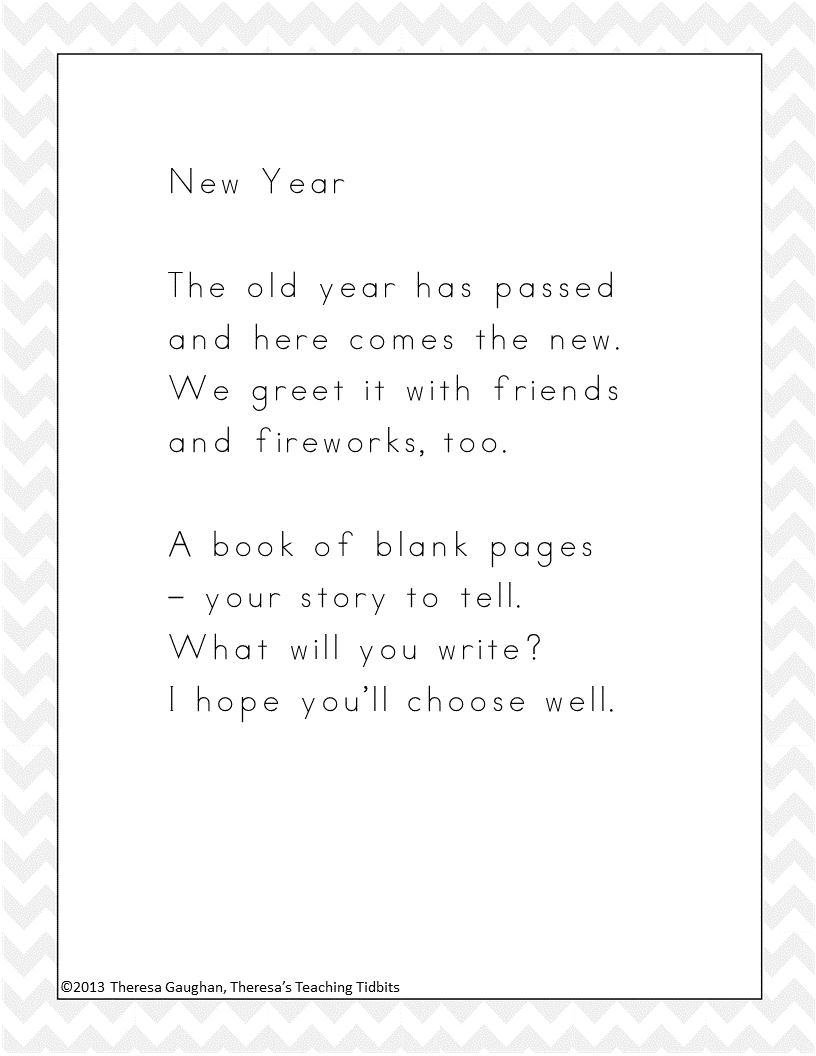
Once we go back to school, I'm going to encourage my first graders to make goals for the new year as well.  I'll share my New Year poem with them and talk about making resolutions and setting goals. 


I'll use the activities from my newest TpT product to help set the stage for a successful new year of learning.

Here's an updated picture from December 2017 of some of the activities in Happy New Year! Fun Literacy Activities to Welcome the New Year.


If you need a fun literacy unit to kick off the new year, you can get it here.

Wishing everyone a happy and successful New Year!   

Wednesday, July 24, 2013

Read Alouds for the First Week of School

Read-Alouds for the First Week of School

Reading aloud is an important part of my classroom.  It is especially important at the beginning of the year.  The books you choose to read aloud set the tone for your classroom community and teach lessons that will last the whole year!


Disclaimer- this post contains affiliate links which means that I earn a small amount when you make purchases (at no extra cost to you). However, my promise to you is that I am only sharing my honest opinions and I will never promote something I do not believe in.

Here are three of my favorite first week read-alouds:


Shubert's BIG Voice by Dr. Becky A. Bailey and Leigh Ann Burdick
This is an adorable story about a lightning bug named Shubert who has an encounter with a bully named Benny on the first day of school.  His magical teacher, Mrs. Bookbinder, teaches him to use his "Big Voice" to stand up for himself. 

I've been reading this book on the first day of school for years and my students always enjoy it.  More importantly, I am able to make using your "big voice" an important first step in dealing with conflict.  My students learn to tell others, " I don't like it when you..." and often, this results in an apology from the other student.  When students come to me to tattle, the first question I ask is, "Did you try using your big voice?"


Hooway for Wodney Wat by Helen Lester
This story about a rat named Rodney who can't pronounce his R's, is a great way to introduce a lesson on individual differences.  Wodney is often teased by his classmates for his speech. To their surprise, he becomes a hero when a bully named Camilla Capybara joins their class. This book leads to great discussions about what it feels like to be teased and the importance of showing respect for others.


Stand Tall, Molly Lou Melon by Patty Lovell
This is another story that I use to help students value differences and stand up for themselves.  Molly Lou Melon is a tiny first grader with buck teeth and a voice "like a bullfrog being squeezed by a boa constrictor." When she moves to a new town, she encounters Ronald Durkin, a student who delights in picking on her.  You and your students will cheer Molly Lou Melon's self-confidence as she counters each of Ronald's digs with her strengths.  

Of course, during the first week I read aloud many books. These are my favorites for setting the tone for the rest of the year.  Feel free to add your suggestions. :)


Happy reading!


Monday, July 15, 2013

My first blog post!

Wow! I can't believe I'm finally taking the plunge into the blogging pool!  I have been planning to start a blog for a while, but I've been procrastinating. This summer, I decided I just needed to get started.  Of course, as teachers, we know that getting started can be the hardest part.

This summer has been a challenging one.  After eight years at a school in a neighboring county, I began looking for a teaching job closer to my home.  Several applications, emails, and interviews later, I was offered a job at a school just 10 miles away.  I'm so looking forward to less time in the car and more time to spend on my classroom. But now, I have to take care of all the business related to starting a new position - employment physical, fingerprinting, drug test, paperwork, etc.  Ah, the joys of being a teacher!

On my blog, I'll be sharing some of the ideas, activities, and lessons I use in my classroom. I'm a great believer that teachers need to share what they do, not only what works, but also what doesn't. Our profession can be so isolating. In spite of Professional Learning Communities and team planning, we still bear primary responsibility for educating our students.  We close the door to our classrooms and try to make magic happen everyday.  Not so easy.  So, I hope this blog becomes a place where we can share and support each other in our teaching lives.

For full disclosure, I do have a store on Teachers Pay Teachers:
I'll be sharing some of my products on this blog and I hope you will visit my store and check them out.