BlogLovin' Teachers Pay Teachers Email Pinterest Facebook Image Map

Monday, May 31, 2021

How to Host a Summer Book Exchange Event in 10 Easy Steps


Collage of Pictures from Summer Book Exchange Event

It's hard to get kids excited about reading when summer vacation promises lots of time with friends, family vacations, and outdoor fun. And of course, we want them to do all those fun things during summer break. We just want them to spend time reading, too!

One of the best ways I've found to get my students excited about reading over the summer is to give them access to lots of books they want to read. A Summer Book Exchange Event does just that.

Hosting a Summer Book Exchange Event is a fun and effective way to encourage students to read over the summer. 

Hosting a Summer Book Exchange event in 10 Easy Steps:

1) Establish and schedule a date, time, and location for the exchange. We held the event in our school media center during the last week of school.

2) Recruit teachers, staff members, and volunteers to plan and run the event. Our grade-level team spearheaded the planning and recruited volunteer parents to help on the day of the event. 

3) Get the word out. We created a flyer to send home asking students to donate unwanted books in good condition.
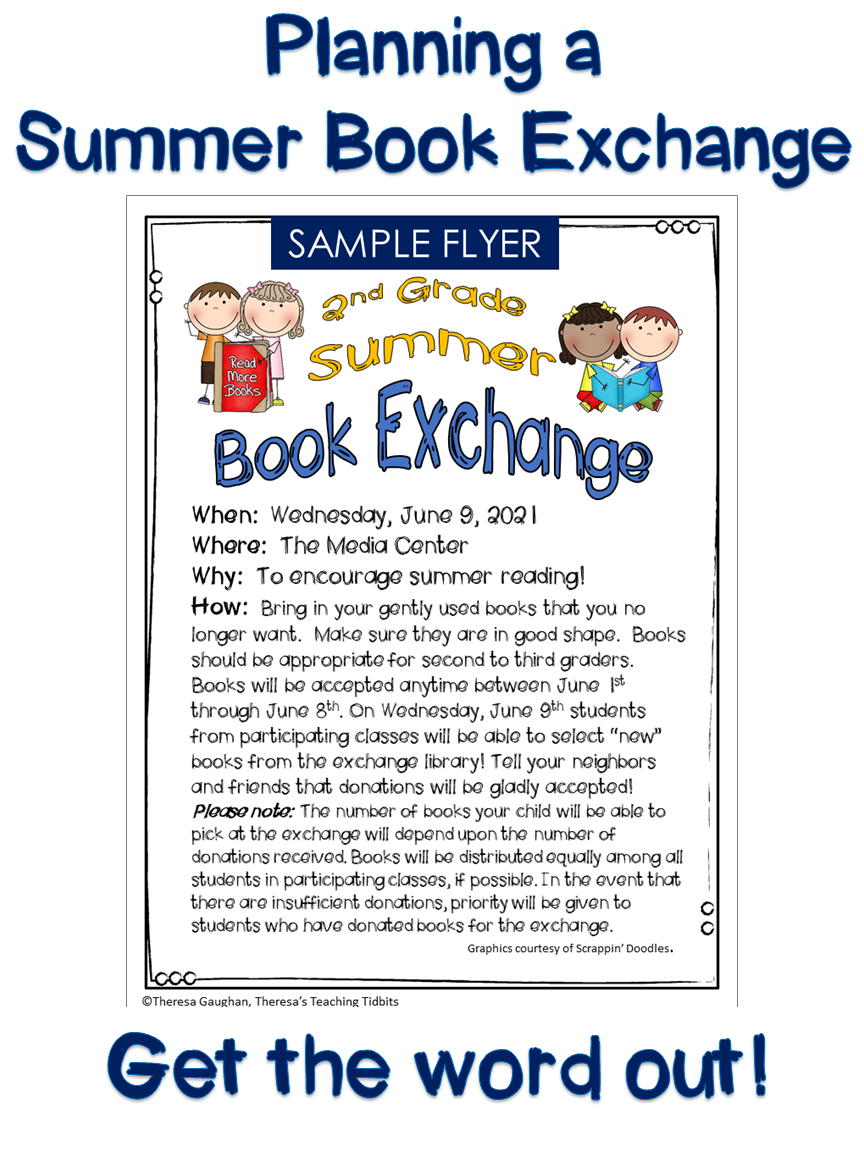
Picture of flyer giving details of Summer Book Exchange Event.


4) Involve your students in the event. We had our students cover and decorate donation boxes to place in common areas and in the community. 


Picture of Donation box decorated by students which reads "Donate old Books"
5) Involve the community. Ask small businesses, churches, or community centers if you can place a flyer and donation box at their location. Arrange to pick up donations in a timely manner. Don't forget to have students write thank you letters to send out after the event. 

6) Organize and count donated books as they come in. Parents and teachers worked together on this.

7) Determine the number of books each student will be able to take home. After the collection window closed, we tallied the total number of books donated. We divided that number by the number of students in our grade level. Each student was able to choose several books to take home. *Please note that all students were able to take home books, whether they had donated to the exchange or not. 

8) Organize and display the books for easy browsing. We used tables, but you could also use shelves, library carts, baskets, or even the floor to display books. 

9) Allow students ample time to browse. Teachers and volunteers should assist as needed. We allowed students to browse in shifts. Smaller groups of students led to fewer conflicts and a little less chaos. 

Students browsing for books at Summer Book Exchange Event.

10) Encourage students to read their new books over the summer! 

Or, immediately as the students in the picture below did. 😀
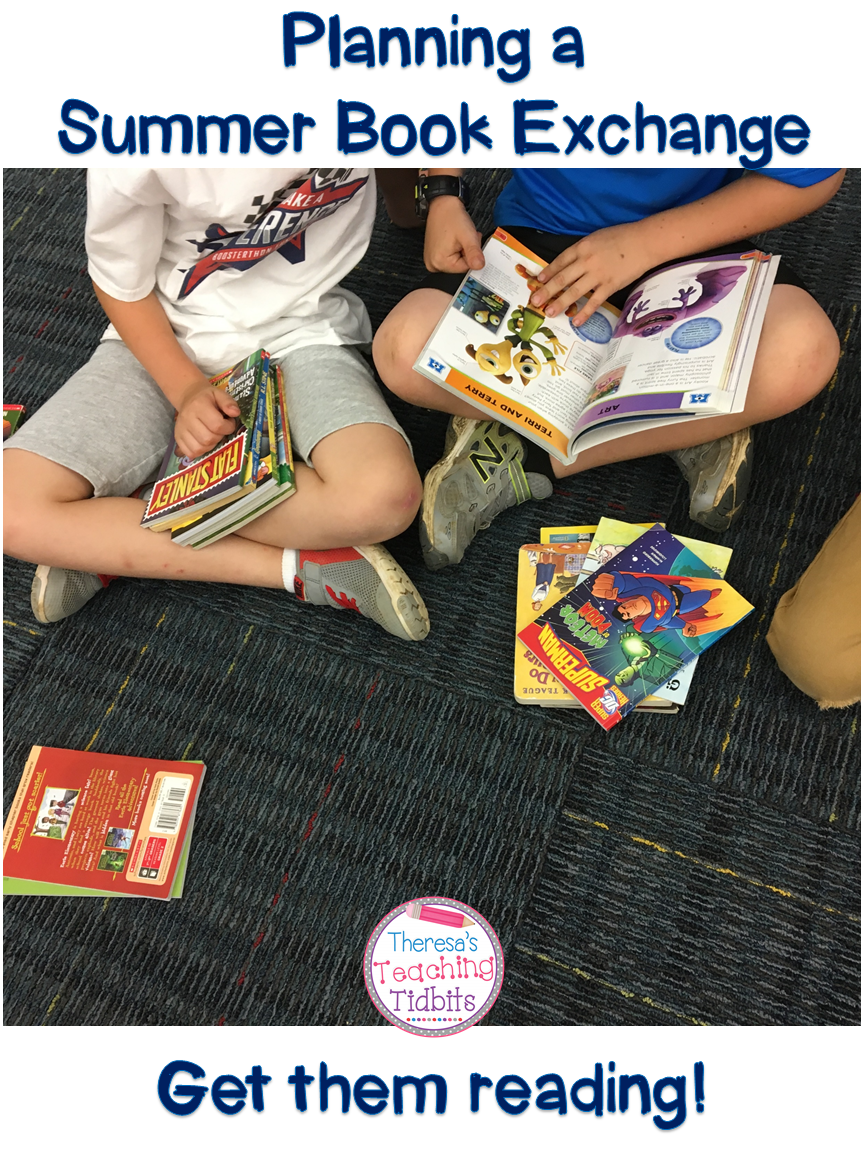
Students reading books

If you are a little bit hesitant about planning a large event, start small. My first book exchange event involved just my students. Even if students are able to take home just 1 or 2 "new" books to read, that may be more than they had before. Just encouraging students to bring in and trade old favorites sends a powerful message about the fun (and importance) of reading. I hope you will give it a try.

If you are short on time or don't know where to begin, I've done a lot of the work for you! My resource, Editable Summer Book Exchange Suggestions, Flyers, and Letters has everything you need to get started with planning your own event. It's available in my TpT store. 

Picture of TpT resource cover: Editable Summer Book Exchange


Happy Reading!


Saturday, March 28, 2020

Keeping Kids Happy and Learning During Social Isolation

I said goodbye to my class on what we thought was a normal Thursday afternoon. Later that evening, we got the message that schools would close one day early for spring break to allow for cleaning and sanitation due to the coronavirus pandemic. 

Sadly, Covid-19 has now caused our schools to be closed until at least April 24th. I miss the kids in my third grade class and I worry about them during this unprecedented global crisis. This crisis is nerve-wracking for adults and can be even more stressful for children. 

With that concern on my mind, I've been sharing ideas for fun family-centered activities on my Instagram account. Here is a round up of some of the ideas I've shared. 

Family Game Nights


Family game nights are a great way to have some fun and keep kids learning at the same time. In this picture from December, my great-niece(age 4) and my great-nephew were playing Shut the Box. It’s a great game for little ones to practice counting, number sense, and simple addition. For older students, Monopoly, Rummy, Yahtzee, or Scrabble would all make for a fun family game night. Best of all, no technology is allowed!

Get Outside! 


Take a nature walk. Encourage your children to act like scientists. Have kids bring a camera and/or a journal to record their observations. Point out signs of backyard wildlife. Look up information online about the things you see.

Or you can create a Springtime Scavenger Hunt. 

You don’t need a commercially produced form to go on a scavenger hunt with your kids (although there are many available online). Before going for a walk, sit down together and make a list of things people might see in the springtime. Then, grab a camera or a journal and see how many of those things you can find on your nature walk! Activities like this encourage careful observation, categorizing, and a growing knowledge of the natural world. You can easily incorporate art, writing, reading, and math activities, too. Ask kids to draw or create one of the things they saw. Ask them to write a story or poem about the their walk. Encourage them to ask questions and then research the answers by reading non-fiction books online. Before going on the hunt, assign numbers to each item (10 yellow flowers, 15 trees with green leaves, etc) so they can practice counting, using tally marks, or adding numbers. This is a great learning activity that the whole family can enjoy! 

Try Something New!


Being stuck at home is a good time to try something new. For me, that was making bread! It didn't turn out exactly like the recipe, but I think it was a pretty good first attempt! It looked good and it tasted pretty good, too! There's nothing like warm, fresh bread with butter to satisfy a need for comfort food.

Go for a Drive


Remember when people used to go for “Sunday drives?” It’s a good time to revive that tradition. Take your kids on an exploration while staying safely isolated in the car. Make sure to keep the DVD player turned off and put away all phones. Encourage little ones to find letters or words on billboards and signs. Play the license plate game (how many states can you find?) or the alphabet game (Find words in alphabetical order on signs - who can get from A-Z the quickest?) Go down roads you’ve never traveled before just to see what’s there. Point out livestock or signs of spring. Or, just talk and enjoy each other’s company.

Start a Journal


Writing in a journal can be a healthy outlet for you or your children during times of stress. It’s a great place to express emotions or figure things out. It’s also a creative outlet! Journals can be a great place to brainstorm ideas, to write poetry, to sketch pictures, or to outline a novel. You’ll enjoy surprised at how much better you’ll feel after journaling!

As my friend Crystal at Primary on the Prowl pointed out, "Also journals that are kept now will be considered primary sources in the future!" Can you imagine your journal informing historians 20, 50, even 100 years from now? It's mind-boggling!

Begin a Family Read-aloud


This is a good time to start a new tradition - the family read aloud! Reading together provides not only a shared experience, but a sense of comfort and escape from current troubles. There’s also ample opportunity for conversations that strengthen reading comprehension! Your child will benefit from listening to fluent reading, making connections, predicting upcoming events, evaluating character choices, and visualizing settings or events. That’s a lot of learning for just ten to thirty minutes a day!

Two More Things

I'm trying to do my part to help. With that in mind, I've recently posted two new freebies in my Teachers pay Teachers store.

The first one contains more ideas for family activities during this crisis (or for any time kids are out of school). You can download your Family Friendly Activity Calendar by clicking here. 


My other freebie is about helping children stay mentally healthy. I wrote this poem and added some conversation starters/writing activities so adults can help kids process their feelings and develop coping strategies during this scary time. You can download The World Can Be So Scary here. 


I hope everyone stays healthy and safe. Keep busy and stay positive! We're all in this together.

Until next time, 

Sunday, July 21, 2019

Veteran teachers Share 11 Awesome First Day Read-Alouds

As another school year gets underway, many of us are squeezing in a few last vacation days before heading in to set up this year's classroom. Some of us are trying to make sense of chaos as we get ready for Meet the Teacher Day. And some of us already have classrooms full of kids. With that in mind, I asked some veteran teachers to share their favorite first-day read-alouds. I got some great responses and I'm happy to pass them along.

Disclaimer- this post contains affiliate links which means that I earn a small amount when you make purchases (at no extra cost to you). However, my promise to you is that I am only sharing my honest opinions and I will never promote something I do not believe in.

Let's start with my new favorite first day book. 


The Day You Begin by Jacqueline Woodson is a wonderful book about how we all feel like outsiders until we begin to share our stories. Once we are brave enough to do that, we discover that we are not so different after all. I'm looking forward to sharing it with my third graders this year as we build a classroom community where individual differences are appreciated, respected, and valued. 


Veteran teachers Becky from Overheard in Kindergarten, Crystal from Primary on the Prowl, and Brianna Krebs rave about First Day Jitters by Julie Danneberg. Crystal even wrote a blog post about how she makes Jitter Juice with her class. Such a fun way to start the year! Brianna says, "Always a "go to" for me! Teaches my kiddos that their teacher was just as "nervous" for the first day of school as they were!"


Becky's second recommendation is Miss Bindergarten Gets Ready for Kindergarten. She says, "I like to tell the class what I did to get ready for kindergarten. Then, have students practice taking turns to speak and share what they did to get ready for kindergarten."


Becky's third recommendation is a new favorite, The Pigeon HAS to Go to School by Mo Willems.


Kelli from Kelli C's First Grade recommends two books. The first is The Secret Shortcut by Mark Teague.


 Kelli's second pick is Officer Buckle and Gloria by Peggy Rathmann. "They talk about safety tips at schools.. we use this to open up a discussion for our classroom rules and we talk about making the classroom a safe place."


Yvonne from Journeyed Transformations recommends You're Finally Here! by Mélanie Watt. She pairs the book with some fun activities created by Linda Kamp.


Kayla from K's Classroom Kreations loves to use the book, Chrysanthemum by Kevin Henkes with her first grade class. 


Literary Sherri recommends The Teacher from the Black Lagoon by Mike Thaler. "It makes students laugh and puts them at ease. :)"

For our final recommendation, veteran teacher Pat McFadyen says, "As a math/science teacher, I loved reading Math Curse the first day! It's funny and I could share my love of math humor!" What a great way to help students see that learning math is fun!


What are your favorite first day read alouds? Post them in the comments below.

Have an awesome school year!

Monday, June 10, 2019

13 Amazing Anchor Charts that Help Build Classroom Community

Anchor charts are incredibly helpful tools. They provide learners with visual reminders of concepts, procedures, skills, and strategies. Here are some great anchor charts that I've created, used, or found on Pinterest that help build classroom community and hold students accountable. Make sure you pin these to your Pinterest boards for future reference!


Disclaimer- this post contains affiliate links which means that I earn a small amount when you make purchases (at no extra cost to you). However, my promise to you is that I am only sharing my honest opinions and I will never promote something I do not believe in.


1) Creating a class promise is a great way to set expectations for the classroom community and hold students accountable all year long. You can find out more about how to create one in your classroom by reading this blog post.


2) Here's an anchor chart that sets expectations for math talk. Students have clear guidelines for their conversations. Again, this is a way to hold them accountable.


3) Need a way to remind students how they can be good friends? Work together to create this anchor chart.


4) Teach your students how to disagree respectfully with this awesome chart.


5) Set your expectations and keep the noise level under control by creating this visual reminder.


6) Encourage meaningful apologies. Some students have never been taught how to apologize.


7) Teach students what it means to be a good classmate. Brainstorm ideas with your class, so that they take ownership.


8) Make classroom procedures a daily habit.


9) Lots of procedures make for a happy classroom!


10) Create a classroom full of bucket-fillers! You'll want to create this chart after reading one of the Bucket-Filler books by Carol McCloud. Have You Filled a Bucket Today? is my favorite!


11) Establish expectations for small groups.


12) Develop self-directed learners!


13) Encourage a growth mindset.


If you love creating and using anchor charts in your classroom, make sure you follow my Pinterest board.

If you need more information on how to create and use anchor charts with your students, I recommend Smarter Charts by Marjorie Martinelli and Kristine Mraz.


What do you do to help build your classroom community? Please share in the comments.

Until next time,

Sunday, September 2, 2018

Becoming a Reader


My great-nephew Ben is a reader. He loves books and stories. The picture I used above is from 2 years ago when he had just finished first grade. Mo Willems had become a favorite author and I had just given him several new Elephant and Piggie stories. 

Today, he sent me a picture of his favorite lines and illustration from The Wild Robot by Peter Brown. He wanted to share them with me because he knew that we have something important in common - we are both readers.

It occurred to me as I was reading his text that I don’t remember learning how to read. 

I don’t remember memorizing sight words or practice sessions with flash cards. 

I know I probably did reading worksheets in school, but I don’t remember doing them.

I grew up in the age of round-robin reading, Dick and Jane books, and bluebird, redbird, brown bird reading groups. But that’s not what I remember.

I remember singing alphabet songs, reciting nursery rhymes, and gathering for story time at the foot of my teacher’s rocking chair.

I remember sitting on my mommy’s lap while she read us a book. I remember sitting by her side as she encouraged me to sound out a word in Mr. Brown Can Moo.

I remember seeing my mom, dad, grandfather, and grandmother reading books and newspapers. 

I remember sitting at the dining room table as my grandfather read my brother and me the Sunday Funnies.

I remember playing the billboard game on every single road trip. My brother, sister and I would compete to find words starting with a-z on road signs and billboards. Whoever reached the end of the alphabet first would win. 

I remember going to the library and searching for Babar and Harold and the Purple Crayon books. I remember how excited I was at 5 years old when I got my very own library card with my name on it.

I remember discovering new series and being encouraged to read every biography in the children’s section. 

I remember reading books to my little sister, sharing my favorite stories and authors with her.

As a child in poverty, I remember how excited I was to gather a stack of books to trade for credit at the used bookstore. Checking out with a stack of new books. Riding in the backseat of the car to the park trying to decide which one to read first. Losing myself in a story while nestled in the trunk of a sprawling banyan tree.

I remember reading the Little House books because my mom loved them as a child, Charlie and the Chocolate Factory because the librarian thought I might like it, The Hobbit because my brother was reading it, and Charlotte’s Web because my teacher read it out loud to our class.

I remember receiving books as Christmas presents and Birthday presents. I couldn't wait until all the excitement was over so I could dive into a new world.


No, I don’t remember learning how to read.

I just have wonderful memories of becoming a reader. 


My great-nephew sent me these pictures from The Wild Robot
by Peter Brown. He said it's a sad book, but it makes him happy.

I suspect Ben is the same way. He doesn't remember or care how he learned to read. He became a reader in a family of readers. He's a reader who truly enjoys reading and loves sharing that joy with others. He is a reader because he loves stories. He's a reader because he sees examples of readers in his own life. He's a reader because after Mo Willems, he found more favorite authors and more favorite books and more favorite series. He's a reader because he has learned not only how to read well, but to find joy and comfort in books. He has become a reader. 

I think one of my most important jobs as a teacher is to help more kids to be like Ben - to help them become readers, too. I try to help students become readers by modeling my own love of reading, by sharing my excitement when I find a new author or story that I love, by recommending books I think they will love, by reading aloud each and every day.

What about you? How do you ensure your students are becoming readers?

Thursday, July 13, 2017

Veteran Teachers Share Terrific Tips for Building Positive Parent-Teacher Relationships

Image by Speech Language Pirate

I've been teaching for twenty years now and I can honestly say that parent-teacher relationships are one of the most important (and often overlooked) keys to a successful school year. One difficult parent, or even one misunderstanding or miscommunication, can lead to a year from ... well, you know.

With that in mind, I posed a question on my Facebook page: How do you establish and maintain a good relationship with parents? Some awesome veteran teachers shared their wisdom. Although I originally intended to write this post for beginning teachers, the tips are so good that I think all teachers can find something new to implement!

Tip #1  First Impressions Matter!


Eliene's advice was echoed by other teachers. Laura Howland Aquilone says she "call[s] all my parents after the first week to get an at home perspective." Hilary Philpott-Gard says she tries "to send every parent a positive e-mail about their child by the end of the first month."

I know that I consider Meet the Teacher Day to be one of the most important days of the school year. It's my first opportunity to get to know parents and to let them get to know me. Letting them know that I care about their child as a person goes a long way toward starting a good relationship. I make phone calls to the parents who are unable to attend due to work or other commitments. It's so important for that first contact to be friendly and positive!

Tip #2  Keep It Positive!    


Crystal Cash White agrees. She advises, "Start the relationship early and keep it positive!" 

The First Grade Flair says, "Try to communicate positive things, too! So often teachers are just calling and emailing when something is wrong. Positive notes and calls go a long way in building trust between us and parents. I try to do 2 positive notes a week usually on a Friday and I track to make sure each student gets at least one a year." 

Believe me, this is excellent advice! I send home Happy Notes to my parents a few times a month. I keep track on a simple class roster in my communication binder to make sure everyone gets one. The parent's often surprised, yet happy reply never fails to make my day!


Tip #3 Make Parents Feel Welcome!


Linda Griffin had some great suggestions. "Have lots of special days that you invite the parents in to help with activities etc. We have Grandparents and Special Friends Day, Thanksgiving play and feast, Christmas/Holiday Spectacular, parents help make things and do activities, Field Trip Chaperones, Spring Fling/Easter egg hunt and activities, various other opportunities for parents to come in and share and then our Graduation and play. These help parents see their child and you interacting in the classroom."

Parents love to volunteer. Don't be afraid to ask parents to help in the class. Ask them to read or practice sight words with a child. If you have trouble giving up control, start a Guest Reader or Mystery Reader program to get them in. Ask them to help with copying, laminating, or other clerical tasks. You will help parents to feel welcome, build that relationship, and get some help with your overwhelming workload. It's a win-win!

Tip #4  Use Technology!


Other teachers suggested communication apps, as well. Donna Murphy writes, " I use Class Dojo with my class. Give parent[s] a look into what is going on and it is using technology. Something that is always looked for in a classroom."  Hilary Philpott-Gard uses Bloomz and sends "tons of pics in the first week or so." 

Deann Marin shared a great idea: "We do a video titled A Day in the Life of Your Child for parent night. We follow the kids to all their classes, PE, Art, etc, even to the cafeteria for lunch. We tape each other teaching. Parents love seeing their kids. They see first hand our teaching style. They can tell we care. Once they realize this, they're very happy. Great ice breaker."

Other teachers I know have a classroom Facebook page, Twitter account, or blog. Use the technology you're comfortable with to connect with parents.

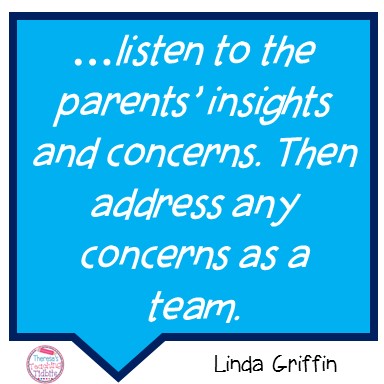
Tip #5 Listen and Address Concerns!


This is such a great tip. Too often, teachers view parents as the enemy. It's important to remember that whether or not you agree with their concerns, parents are acting as their child's advocate. Take the time to listen and be as objective as you can when a parent raises a concern. Work together to find a solution.

Aren't these terrific tips? I know I was able to find something new to try this year. I hope you did, too. If you have a tip to share, please add it in the comments below!

If you're having a parent conference, make sure you check out the tips in this post.