BlogLovin' Teachers Pay Teachers Email Pinterest Facebook Image Map

Saturday, March 12, 2016

Five for Friday... on Saturday again


I'm later than normal with my Five for Friday Saturday, but I have a great excuse. Today, I spent the day with some fellow educators at the NCAEE Southwest District 6 Conference. Yes, I did go to PD on a Saturday. Yes, I did spend my own money to do it. Yes, I am a little crazy, but I'm so glad I went. I got some much needed inspiration.

Here are this week's five things.


I've wanted to share this one with you for awhile. These are the class buckets in my colleague's classroom. When a student does something kind and "fills someone's bucket," they get to drop pom-poms in their class bucket.  When they fill their bucket with pom-poms, they get to visit the treasure box. Then, they empty their bucket and start over. I think this is a great way to encourage and reward kindness in the classroom, don't you? I'm definitely trying it next year!


I saw these at Target this week in their Easter section. I'm thinking I could design some great math lessons that revolve around Goldfish. We could graph the different colors and analyze the graph. We could work on even and odd numbers. We could estimate and count the whole bag. We could work on place value. We could solve two-digit addition and subtraction problems. We could make up our own story problems. Hmmm.  The possibilities are endless. I'm thinking the weekend before Spring Break would be perfect for these. I'll let you know what I decide to do and how it goes.


Check out what I saw hanging in the teacher restroom at the school where the conference was held today. I think this is a great idea - both for teachers and for students. Sometimes, we just need a little reminder; something positive to let us know that we do matter, that there are people who care about us. So cool.


I won a door prize!  I chose this book by Ron Clark. I can't wait to read it. Visiting the Ron Clark Academy in Atlanta is definitely on my bucket list.


I got to spend time with one of my teaching idols today. I started reading Jen Jones' Hello First Grade blog soon after I moved to North Carolina. I've found and used so many wonderful ideas and resources on her blog over the years. Now, of course, her blog is called Hello Literacy. She is a popular TpT Author and a literacy consultant in high demand across the country. She's also an inspiring presenter. Just listening to her today erased some of the stress I've been feeling lately. I'm feeling reenergized and ready to teach students to become better readers and writers.

I'm grateful to Doodle Bugs Teaching for hosting Five for Friday each week. I enjoy sharing my week with you and finding out about what other educators are doing. Make sure you visit Doodle Bugs Teaching to check out the other great blog posts this week. I also welcome your comments on my blog. Make sure you follow me on BlogLovin' by clicking the link at the top of my page.

Until next time,

Monday, March 7, 2016

Math Tip Monday: Spring Math Ideas and a FREEBIE!


Kayla, from K's Classroom Kreations, and I would like to welcome you to this month's Math Tip Monday!

I'm excited to share my spring math idea with you this month. Those of you who have read my blog or used my products know how much I enjoy using poetry in my classroom. While teachers often teach poetry in the springtime, I wonder how many of us think about using poetry in our math instruction. This month, I created a poem that is perfect to use for a spring graphing lesson.  


After introducing the poem as part of my Poem of the Week program, I can easily connect the poem to my math lesson. First, my students use the data in the poem to complete a tally chart. Believe it or not, in second grade, I still have a few students who have difficulty with the concept of tallies. We review tallies as a way to record or keep track of our data.

Next, we create a bar graph to show the data.  My students love to make bar graphs, so this is a fun activity for them. We then compare the Tally Chart and the Graph to make sure the data matches on each. We talk about the importance of recording accurate data.


Our next step is to analyze the graph. I always start by having students volunteer things that they notice about the data. I find that my students often understand and analyze a graph more deeply when they are asked what they notice, rather than immediately asked to answer questions about the graph.

After our discussion of their ideas, which I note on chart paper, I hand out the questions for independent or partner work. I usually pull a small group of students to work with me.  


As a follow-up lesson, I'll have my students go outside with their math journals. We'll observe the creatures around our campus and note how many of each we see.  Later, we'll create a graph of our own data and analyze it. Often, I'll have students create their own questions about their graphs. Then, they trade with a partner to answer each other's questions.


Connecting poetry with math is a great way to keep students engaged and to present information in a different way. If you'd like to use this lesson, you can download it for free here


If you enjoy linking poetry and math, you may be interested in my Math Poems for Fun and Understanding K-2


If you'd like to find other math poems to link with your teaching, check out these online resources.

Smart by Shel Silverstein 

Can Teach Songs & Poems

Greg Tang Math


If you have other poetry and math resources that you use, please share in the comments below.

So that's it for this month. I hope you will check out the other great ideas in our linky by checking out the blogs below.


Saturday, March 5, 2016

Five for Fraturday

Happy Saturday!  I'm back to link up with Doodle Bugs Teaching and share five things from this week.  


I love Dr. Seuss' birthday week, don't you? This week our school celebrated Read Across America week. My kids loved it!

I'm cheating a little bit because I forgot to take a selfie this time. The photo is from last year, but, of course, I had to wear my Cat in the Hat outfit again. 


Our lovely school nurse, Mrs. A. came in and read to my class on Friday.  She read the book, Inside Your Outside: All About the Human Body from the Dr. Seuss Learning Library.She had the kids rhyming right along with the text and made learning about the human body fun. We're lucky to have a school nurse who's a fantastic teacher, too.


We also had a visit from our local theme park. The Carowinds Reading Program sent a reader and a surprise guest. They were also kind enough to give each of our students a bookmark with a free pass to Carowinds attached to it. The kids absolutely went bonkers - in a good way. 


Wednesday was Wacky Wednesday, of course.  We spent a lot of way too much reading time looking for all the crazy things in the illustrations, but the kids loved it! Afterward, we did some critical thinking and writing about the book, so that made the time spent worthwhile.


Ultra mega mega fun, indeed.

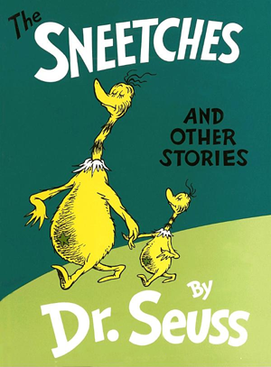
I very sneakily planned some social skills lessons this week, too.  Last week, we had worked on determining the lesson or moral of a fable.  This week, I used some modern-day fables written by Dr. Seuss to talk about accepting differences (The Sneetches) and compromising with others (The Zax). Both of these great stories can be found in The Sneetches and Other Stories by Dr. Seuss.


That's it for this week. Make sure you check out all the great Five for Friday posts from my fellow bloggers. And don't forget to check my blog on Monday for this month's Math Tip Monday post. I'll share some ideas for connecting math and poetry in the primary grades.

Saturday, February 27, 2016

Five for Fraturday: STEAM Night

For this week's Five for Fraturday, I want to share some pictures, ideas, and thoughts about our school's STEAM Night. Thank you to Doodle Bugs Teaching for hosting!


I wrote about last year's STEAM Night in this post. This year, one of my colleagues and I wanted to try something different. We had attended a STEM Conference at UNC-Charlotte. At one of the sessions, we learned about an elementary school whose teachers hosted a parent night for Pre-K to First Grade that revolved around STREAM (Science, Technology, Reading, Engineering, Art, and Mathematics). We were excited about the idea and discussed it with our K-2 teachers.  They quickly jumped on board and we decided to add a hands-on element to our already scheduled STEAM Night. While different grade levels had different activities, I'm going to share the ones I decided to use in second grade. They are either aligned to or an extension of our second-grade curriculum.


Oobleck!

I have to start off with the favorite station of the night, Oobleck. We connected each of the stations with appropriate books and, of course, this one was tied to Bartholomew and the Oobleck by Dr. Seuss. We've been teaching about types of matter and how matter changes, so this was a natural fit. For those of you who've never experienced it, Oobleck is a non-Newtonian liquid. In some ways, it acts like a liquid; in others, it acts like a solid. For me, the kids, and their families, it was just lots of fun! 


If you'd like to try it, the recipe is simple: 1 part water to 1.5-2 parts cornstarch. Add a little green food coloring to the water before mixing and that's it. Make sure you cover your work surface with newspaper or bulletin board paper. It does get messy, but the looks on the kids' faces are worth it!


Water

This year, the kids learned about weather and the water cycle. I thought a nice extension of that would be a couple of experiments related to surface tension and adhesion. First, students explored how many drops of water could fit on a penny. I provided recording sheets from Lakeshore Learning, the water, pennies, and some droppers. Our families loved exploring surface tension! Some of them were very surprised when they found out how many drops would fit.


I'm sorry that I somehow I missed taking pictures of our other water experiment. In this one, students used a toothpick to try to drag a drop of water along a path from start to finish. We spread waxed paper over the activity sheet (a simple picture of a curvy path with a start and finish line). The students used the dropper to put one drop of water at the start. They then dragged the water along the path to the finish. Simple, but fun - and a great demonstration of the property of adhesion (water is attracted to other substances). 

We also had several weather and water-related books at this station that our families enjoyed. My favorite is The Magic School Bus At the Waterworks


Sound

We had two activities at this station along with several books that dealt with sound. 

Mystery Sound Canisters is a great activity to explore our sense of hearing. I put several different objects in separate film canisters: marbles, rice, pennies, rubber bands, dry lima beans, and paper clips. I labeled the containers A, B, C, D, E, and F and then taped them shut. Students and families tried to identify the objects by gently shaking the canisters and listening closely to the sounds. Not an easy thing to do! I tried to share this activity with you, but because I created it on my workplace google drive, I wasn't able to. Here are the pictures of the slides so you can create your own if you'd like.


We also explored pitch, vibration, and sound waves using tuning forks. We were lucky enough to get a set of tuning forks with our new science kits last year. The kids had a blast making the rice "dance" on the waxed paper using the vibration of the tuning fork.


Here are the directions for this activity:
Life Cycles

It really bothers me that I didn't take pictures of all the books we had out. What was I thinking? Anyway, we brought out a ton of books about animal life cycles. We haven't begun this unit yet, so I wanted to do a simple activity just to introduce the concept and review prior knowledge. I had several life cycle models on display. Some came from our science kit; others I had picked up at Michaels. A colleague also had a cute center with pictures of animal life cycles that students could put in order. I provided life cycle sheets, paper plates, and supplies so students could create their own model of their chosen life cycle. Not many of the kids completed this activity, but a few of them really enjoyed it!


STEAM Night was a welcome reminder of why I enjoy teaching. I didn't have any data to record. I didn't have to complete any paperwork. I didn't have to mediate any arguments. I didn't have to motivate anyone to complete their work. Students were naturally engaged and excited about learning. Some parents had to literally drag their children away. The event was supposed to end at 7:00. The last family reluctantly left at 7:25. Our principal had to do an all call to tell them to go home.  

While we had a willing audience - only about 1/3 of my class was there - I wonder how our days would go if we were always allowed to teach this way. The students who did come were excitedly sharing their experiences with their friends the next morning. The ones who couldn't make it begged me to do some of the experiments in class that day. 

It was a reminder that I need to make learning fun and engaging everyday. It isn't always easy, because I'm bound by district and state mandates, but I can try.


Our STEAM Night was awesome - for the students and for me.  Have you ever hosted anything like this? I'd love to hear about what you did. I'm planning to do this again next year and I'd love some new ideas. Please share them in the comments!